.
👈


📱 Launch 504 Custom Educational Websites for Just $30/Year
No coding. No hosting. Just results.
Empower your classroom, tutoring service, or educational platform with 200 custom calculators and 304 math exam tutor sites—all hosted and maintained for you. That’s 504 personalized tools for just 6 cents each per year.
✅ Zero technical setup
Just email us what you want updated—we’ll handle the rest.
✅ Instant deployment
Your tools go live fast, optimized for mobile and voice search.
✅ Built for learning
Designed to support memory recall, personalized study, and exam prep.
🎯 Who It’s For
Teachers who want ready-to-use digital tools
Tutors scaling their services without tech overhead
Students needing reliable, on-demand study aids
Anyone who believes learning should be accessible and affordable
Never forget. Always be ready.
With IN-V-BAT-AI, your knowledge lives in the cloud—ready when you are.

IN-V-BAT-AI solution to forgetting! No coding. No website hosting.
Remember on demand is now possible!

Using AI - Voice to Text Keyword, Phrases or Number Type here > tap SEARCH 2
Basic Impulse Level Reviewer


Is your power transformer installed in area where lightning is frequently occurring? During forensic investigation of your failed transformer, is the damaged region near the top of the winding? If it is true, is there a technical solution to address this observation?
Is lightning impulse a good example of
partial discharge. ⤵ What do you think ?
Partial Discharge Measurement and Simulation from CWIEME
Click the play button to watch the presentation in You Tube

The De-Energized Tap Changer (DETC) of a 3 phase power transformer was set at primary voltage of 67 kV and the OnLoad Tap Changer (OLTC) at secondary winding is set at 13.75 kV as the rated voltage also called the secondary voltage. If you look at transformer nameplate, the neutral voltage is indicated by letter "N"; Calculate the Voltage Ratio at the given DETC & OLTC tap settings. This voltage ratio or turn ratio is your baseline value for a healthy transformer with respect to normal winding turn to turn ratio. If there is no turn to turn short circuit on your primary windings or secondary windings the voltage ratio value or turn ratio value should remained very close to your voltage ratio baseline value. Assuming that the instrument was properly calibrated.
Problem #1, Valid for 3 Φ , Δ - Y only, using voltage measurement to solve for turn ratio
|
turn ratio =
|
= |
Δ, kV Primary * 1.732
Y , kV Sec. Voltage
|
Δ - Y turn ratio / √ 3 =
for 3 Φ , Y - Δ turn ratio


This is one example of INVBAT.COM - A.I. useful immediately to students, teachers, employees, and parents who wants to save money on expensive tutor.
If your primary winding is starting arcing or shorting due to dielectric paper or oil insulation breakdown, you will expect to have a trending of lower turn ratio (a) in your TTR measurement compare to factory test report. It is also indicated by primary voltage reading trending towards lower value. Lower your primary voltage from 67 kV to 49 kV. This will lower your turn ratio from normal value of 8.43 to abnormal value of 6.17 (a = 6.17). When you notice your primary voltage trending down to 49 kV it could be a good indicator for possible primary winding is developing a shorted turn to turn winding condition. Remember the fundamental principle that induced voltage is directly proportional to frequency and number of turns of coil conductors in HV and LV windings. if your winding turn number (N) value is trending downward because of turn to turn shorting, then your voltage measurement will be your confirmation evidence. The fundamental physics principle of induced voltage says if your number of turns of your winding coils is decreasing due to turn to turn fault, then you must expect to see the induced voltage to go down also.
V ∞ f * N [ induced voltage is directly proportional to frequency and number of coil turns ]
Problem #2, Valid for 3 Φ , Δ - Y only
Given three phase turn ratio 8.4396 and Secondary voltage 13.75 kV; Calculate the expected primary voltage
|
three phase turn ratio, a
|
= |
kV Primary Voltage * 1.732
kV Secondary Voltage
|
Click white input box to enter new number
If your secondary winding is shorted, you will expect to have a higher turn ratio (a) in your TTR measurement compare to factory test report. It is also indicated by lower secondary voltage reading. Use the calculator below to do simulation. What will happen to your secondary voltage if your TTR reading goes up to 11.521?
Problem #3, Valid for 3 Φ , Δ - Y only
Given a three phase turn ratio 8.4396 and Primary voltage 67 kV; Calculate the expected secondary voltage
|
three phase turn ratio, a
|
= |
* 1.732 Primary Voltage
Secondary Voltage
|
Click white input box to enter new number
Knowing the factory report of voltage ratio (TTR) of the above 3 phase transformer as 8.4396 your baseline for a healthy condition, what do you think happen to the same transformer if the voltage ratio (TTR) from the latest test report is 7.3163 ? Can you estimate the coil location of the Turn to Turn winding short? Can you tell which side of the winding (HV or LV) the Turn to Turn winding short happen? Can you make a generalization about the location of the turn to turn winding short if the TTR test report value is less than the baseline TTR value?
Knowing the factory report of voltage ratio (TTR) of the above 3 phase transformer as 8.4396 your baseline for a healthy condition, what do you think happen to the same transformer if the turn to turn ratio (TTR) from the latest test report is 9.1247? Can you estimate the coil location of the Turn to Turn winding short? Can you tell which side of the winding (HV or LV) the Turn to Turn winding short happen? Can you make a generalization about the location of the turn to turn winding short if the TTR test report value is greater than the baseline TTR value?
Problem #4, Valid for 1 Φ only or 3 Φ Y-Y or 3 Φ Δ - Δ
Given single phase voltage ratio of 4.8727 and Secondary voltage 13.75 kV; Calculate the expected primary voltage
|
Voltage Ratio, a , single phase
|
= |
Primary Voltage
Secondary Voltage
|
Click white input box to enter new number
Problem #5, Valid for 1 Φ only or 3 Φ Y-Y or 3 Φ Δ - Δ
Given Turn Ratio, a , single phase 5.333 and Primary voltage 69 kV; Calculate the expected secondary voltage
|
Turn Ratio, a
|
= |
Primary Voltage
Secondary Voltage
|
Click white input box to enter new number
Assuming from your transformer design review you learned that the primary coil winding turns is 484 for 67 kV tap setting on your DETC and the secondary coil winding turns is 90 to get 12.47 kV and set at Neutral tap setting on your OLTC. Calculate your transformer turn to turn ratio using the given number of turns as your baseline for a healthy condition.
Problem #6, Valid for 1 Φ only or 3 Φ Y-Y or 3 Φ Δ - Δ
Given primary coils number of turns = 484 and secondary number of turns = 90
Given primary voltage 525 kV and secondary voltage 230 kV ; 3 Φ Y-Y
Calculate the expected Turn to Turn Ratio (TTR).
|
Turn Ratio, a , single phase
|
= |
Primary coils or voltage
Secondary coils or voltage
|
Click white input box to enter new number
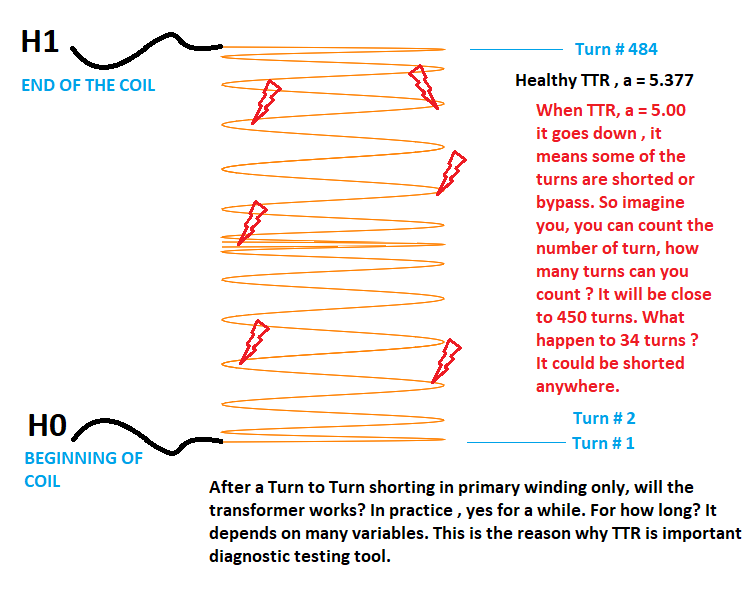
Problem #7, Valid for 1 Φ only or 3 Φ Y-Y or 3 Φ Δ - Δ
Given Turn ratio = 5.3778 and Secondary number of turns = 90; Calculate the expected primary number of turns of coil. Now assuming your TTR value a = 5.00, what is the expected number of turns now in primary winding? How many coil turns have been bypass or short circuited from original 484 turns? Is it possible to locate where they are in your primary winding? Possibly with acoustic triangulation methods of diagnostic.
|
Turn Ratio, a , single phase
|
= |
Primary coils or voltage
Secondary coils or voltage
|
Click white input box to enter new number
Problem #8, Valid for 1 Φ only or 3 Φ Y-Y or 3 Φ Δ - Δ
Given Turn Ratio, a , single phase = 5.3778 and Primary number of turns = 484; Calculate the expected secondary number of turns of coil. How can you tell if the turn to turn short circuit happen in primary winding? Answer, usually if the turn ratio value goes down from the baseline value. For example the baseline value of a = 5.3778 then it goes down to 5.00 what will happen when you enter new value by changing the value of 5.3778 to 5.00? The secondary coil number of turns goes up to 96.8 from original coil turn number of 90. At this point, you know immediately the short circuit happens in the primary winding. How? Because you can't add additional turn in your existing secondary transformer coil. It's number will always stay at 90 turns of coil if nothing is shorted on the secondary winding. Now you know the fault happens in primary winding, try changing the number of turns of your primary coil winding until the value of your secondary coil turns is 90. Try 450, you should get 90 on your secondary coil turns. At this time you do the math and you know there were 34 turns in your primary winding that was compromised. It's location could be anywhere in the primary winding side. VERY IMPORTANT: YOU SHOULD BE CAREFUL IF YOUR HAVE DE-ENERGIZED TAP CHANGER (DETC) OR LOAD TAP CHANGER (LTC) because there is a possibility that the tap settings are changed and it will result in different turn ratio. You should have a baseline record of turn ratio at different tap setting.
|
Turn Ratio, a , single phase
|
= |
Primary coils or voltage
Secondary coils or voltage
|
Click white input box to enter new number
Problem #9, Valid for 1 Φ only or 3 Φ Y-Y or 3 Φ Δ - Δ
Given Secondary FLA = 1296.41 and Primary FLA = 241.28;
Given Primary voltage = 525 kV and Secondary = 230 kV ; 3Φ Y - Y
Calculate the expected turn ratio
|
Turn Ratio, a , single phase
|
= |
Secondary current or voltage
Primary current or voltage
|
Click white input box to enter new number
Problem #10, Valid for 1 Φ only or 3 Φ Y-Y or 3 Φ Δ - Δ
Given Turn Ratio, a , single phase = 5.3778 and Primary FLA = 241.28; Calculate the expected secondary full load ampere (FLA)
|
Turn Ratio, a
|
= |
Secondary current or voltage
Primary current or voltage
|
Click white input box to enter new number
Problem #11, Valid for 1 Φ only or 3 Φ Y-Y or 3 Φ Δ - Δ
Given Turn Ratio, a , single phase = 5.5334 and Secondary FLA = 1296.41; Calculate the expected primary full load ampere (FLA)
|
Turn Ratio, a
|
= |
Secondary current or voltage
Primary current or voltage
|
Click white input box to enter new number
Problem #12, Valid for 3 Φ only
Given 3 Phase MVA rating = 28 and Secondary voltage = 69 kV; Calculate the expected primary full load ampere (FLA)
3 Phase MVA RATED POWER TRANSFORMER
|
Primary, Amp
|
= |
3 Phase MVA Rating
Primary kV * 1.732
|
Click white input box to enter new number
Problem #13, Valid for 3 Φ only
Given Secondary FLA = 1296.41 and Secondary voltage = 12.47 kV; Calculate the expected 3 Φ MVA rating of transformer
|
Secondary, Amp
|
= |
3 Phase MVA Rating
Secondary kV * 1.732
|
Click white input box to enter new number
Problem #14, Valid for 3 Φ only
Given 3 phase kVA = 1000 and Primary voltage = 480; Calculate the expected primary full load ampere (FLA)
3 Phase KVA RATED POWER TRANSFORMER
|
Primary, Amp
|
= |
3 Phase kVA Rating
Primary V * 1.732
|
Click white input box to enter new number
Problem #15, Valid for 3 Φ only
Given Secondary FLA = 2405.70 and Secondary voltage = 240; Calculate the 3 Φ kVA rating of transformer
|
Secondary, Amp
|
= |
3 Phase kVA Rating
Secondary V * 1.732
|
Click white input box to enter new number
Problem #16, Valid for 3 Φ only
Given Primary FLA = 1202.85 and 3 phase kVA = 1000; Calculate the expected primary voltage
|
Primary, Amp
|
= |
3 Phase kVA Rating
Primary V * 1.732
|
Click white input box to enter new number
.
IN-V-BAT-AI helps you to remember on demand even if your memory recall is block by too much worries of daily life. It helps you to organize knowledge in ways that facilitate retrieval and easy to use immediately.
Source: How People Learn II: Learners, Contexts, and Cultures
.
How can IN-V-BAT-AI be used in classrooms ?
The IN-V-BAT-AI solution can be a valuable tool in classrooms, enhancing both teaching and learning experience. Here are some ways it can be utilized:
⋆ Personalized Learning : By storing and retrieving knowledge in the cloud, students can access tailored resources and revisit
concepts they struggle with, ensuring a more individualized learning journey.
⋆ Memory Support : The tool helps students recall information even when stress or distractions hinder their memory, making it
easier to retain and apply knowledge during homework assignments or projects.
⋆ Bridging Learning Gaps : It addresses learning loss by providing consistent access to educational materials, ensuring that
students who miss lessons can catch up effectively.
⋆ Teacher Assistance : Educators can use the tool to provide targeted interventions to support learning.
⋆ Stress Reduction : By alleviating the pressure of memorization, students can focus on understanding and applying concepts,
fostering a deeper engagement with the material.
.


.
.
Try AI website hosting
$30 per year
| Year | Top 10 countries | Pages visited |
| 2023 | 1. USA 2. Great Britain 3. Germany 4. Canada 5. Iran 6. Netherlands 7. India 8. China 9. Australia 10. Philippines | 127,256 Pages / 27,541 Visitors |
| 2024 | 1. USA 2. China 3. Canada 4. Poland 5. India 6. Philippines 7. Great Britain 8. Australia 9. Indonesia 10. Russia | 164,130 Pages / 40,724 Visitors |
| Daily Site Visitor Ranking 7/19/2025 | 1. USA 2. India 3. Canada 4. Iran 5. Latvia 6. Russia 7. Lithuania 8. Polan 9. Brazil 10. China | Year to Date 106,254 Pages / 32,111 Visitors |
Data source: Advanced Web Statistics 7.8